Tanks manage enemy attention and incoming damage, healers restore and protect allies, and damage dealers defeat enemies while handling their assigned mechanics. Choose the role your active specialization and abilities support. A class having a healing or tanking option does not mean every specialization can perform that job effectively.
Match the party label to your actual toolkit
The combat-role reference defines tanks through protecting allies, healers through recovery and protection, and damage dealers through harming enemies. Those descriptions are starting responsibilities, not permission to ignore everything outside the label.
Before joining, inspect your specialization and identify the abilities that let you fulfill the selected job. The official class directory lists available class roles, but your current specialization still matters. Paladin illustrates the distinction: Holy, Protection, and Retribution do different jobs within one class.
| Role | Primary attention | Shared responsibility |
|---|---|---|
| Tank | Enemy control and survivable incoming damage | Mechanics, communication, and positioning |
| Healer | Allied health and recovery resources | Mechanics and personal survival |
| DPS | Defeating relevant enemies | Interrupts, control, and avoiding danger |
If the distinction is unclear, settle the class and specialization choice before selecting a party role. Choosing an unfamiliar role purely because you expect a shorter wait does not prepare the necessary abilities or decision-making.
Tank: make incoming danger manageable
A tank’s job is not simply to attack first or deal the most damage. Enemy attention, defensive abilities, and positioning all contribute to protecting the party. Learn which tools your specialization provides for those tasks rather than assuming one universal sequence works for every tank.
Consider a hypothetical pull where one enemy turns toward a fragile ally while the rest remain on the tank. The useful question is which control or attention-management tool can address that enemy without creating a worse position. Chasing a damage number while the ally remains exposed misses the role’s immediate purpose.
Tanking also does not automatically make you responsible for every route decision. Agree on the pace and ask for help with unfamiliar pulls. If you need a pause to understand an ability, say so before the group moves. Shared planning is more useful than pretending the tank must know everything.
Healer: recover damage without assuming it is all preventable
Healers keep allies alive through healing and protective tools while managing limited resources such as mana. Learn the difference between the recovery options you have and identify what each is intended to address. Do not assume every health deficit deserves the same response.
Suppose several allies stand in avoidable damage while an enemy also performs its normal attacks. Your healing workload rises even though the party’s behavior, not just your spell choice, caused the problem. Address immediate danger where possible, but communicate the mechanic afterward instead of promising to heal through every repetition.
Your own survival still matters. Looking at party health does not exempt you from dangerous ground effects or other encounter instructions. Tell the group when you need a resource pause, and ask about unfamiliar damage patterns before attempting to solve them under pressure.
DPS: contribute damage without abandoning the objective
Damage dealers focus on defeating enemies, but a productive action is not always another attack. Interrupts, crowd control, target selection, and movement can determine whether the group survives long enough to finish. Know which relevant tools your specialization actually has.
Assume an enemy begins a dangerous cast and you have an appropriate interrupt available. Continuing a damage sequence while ignoring an agreed interrupt assignment can harm the run despite a good-looking meter. Coordinate the assignment so several players do not all assume somebody else will handle it.
Likewise, moving out of danger is not wasted participation. A defeated character cannot continue contributing normally. Ask which enemy matters if the group’s target priority is unclear; attacking the nearest target is not always the same as advancing the shared objective.
Prepare the first run as a small team exercise
- Confirm your current specialization and the role you selected.
- Locate your main role tools, a personal defensive, and relevant utility.
- Tell the party if this is your first run or first time performing the role.
- Agree on pauses, unfamiliar mechanics, and any specific interrupt assignments.
- Confirm which difficulty everyone intends to play before entering the activity.
The dungeon-difficulty comparison helps with that last conversation. A group expecting a timed keystone challenge has different planning needs from one discussing an ordinary introductory run. Role preparation and activity selection should reinforce each other.
Afterward, review one concrete moment rather than judging the entire run through a single meter. A tank might ask why an enemy reached an ally. A healer might identify a repeated avoidable damage source. A damage dealer might review a missed interrupt or delayed target switch. Pick one adjustment to practice next time.
Frequently asked questions
Can I queue as a healer because my class has a healing specialization?
Not merely for that reason. Your active specialization and usable toolkit must match the job. A class’s full role range describes available options; it does not make a damage specialization equivalent to a prepared healing setup.
Does the tank always have to lead?
No. Tanks have enemy-control and mitigation responsibilities, but route knowledge and group leadership can be shared. Agree on who is guiding an unfamiliar activity instead of assuming a role label supplies every kind of knowledge.
Is high damage enough to be a good DPS player?
Damage is central, but it is not the only requirement. Ignoring mechanics, assigned interrupts, or survival can prevent the group from completing its goal. Review how your actions supported the encounter, not only the final damage total.
Related guides
- WoW Classes vs. Specializations: How to Choose Your First Character
- WoW Dungeon Difficulties Explained: Normal, Heroic, Mythic, and Mythic+
- How to Import, Save, and Share a Talent Loadout in WoW Retail
Explore the World of Warcraft Guides collection.
Sources and editorial notes
This is a source-based editorial guide, not a personal gameplay test, current-season ranking or guarantee of results. Version-sensitive mechanics, access requirements and item rules should be checked against the current client and developer information. Historical and preview material is not certification of current live behavior.
This guide covers World of Warcraft Retail within the stated source scope, not interchangeable Classic, progression or regional client rules.
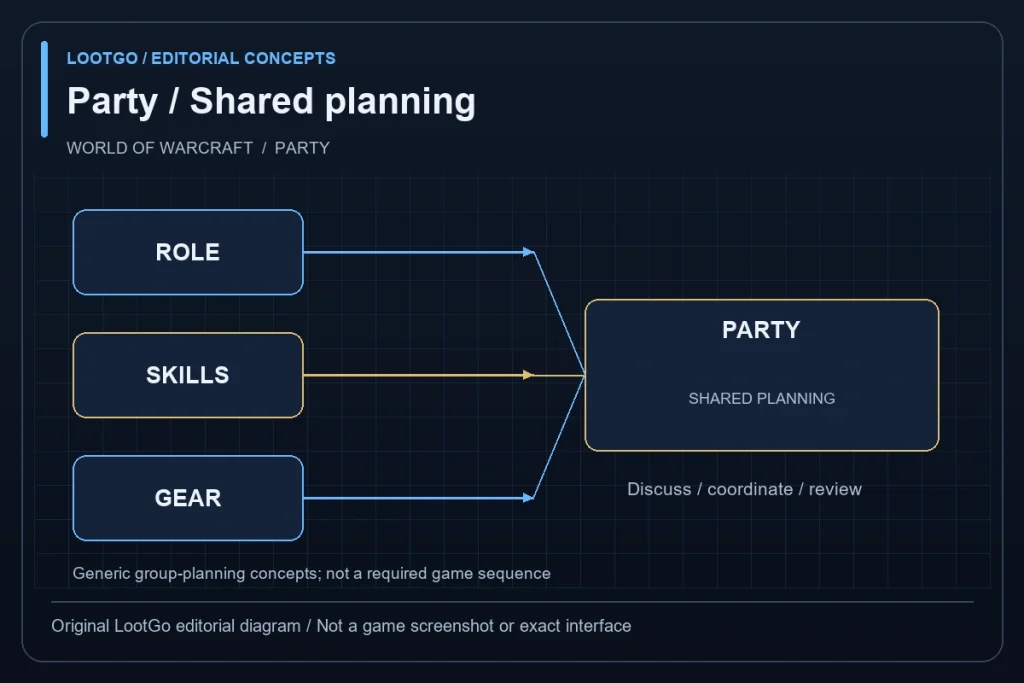
Cover: an original LootGo editorial diagram, not an official game image, gameplay screenshot or exact interface.